

February 19, 2026 · Madrid Ground Signal Edition

IN-KluSo

"When the Building Does the Work"

Year Umbrella: Economies with Purpose

← Back to Archive
IN-KluSo illustration 0 — Madrid rooftops
Core The Signal

When the Building Does the Work

The eviction that doesn't look like one. A legal first in Spain — and what it reveals about the infrastructure of displacement.

IN-KluSo illustration 1 — cracked wall, screwdrivers, construction workers vs residents

On the last day of November 2024, construction workers in a building at Calle Tribulete 7 drove screwdrivers through a partition wall into the common stairway. Fragments of masonry fell into the shared space. Residents were home. The building had been sold eight months earlier to a real estate investment fund — Elix Rental Housing II — whose ownership trace leads to AltamarCAM Partners, one of Spain's larger private equity groups. Police and firefighters came. Then they came again. And again. More than four times in the weeks that followed.

No eviction notice had been served. Every tenant in the building was current on rent.

The Eviction That Isn't

This is the thing the screwdrivers reveal: the eviction that is not legally an eviction. The strategy that requires no lawsuit because the building does the work instead.

In Spain's legal framework, acoso inmobiliario — real estate harassment — has existed as a civil offense for years. It describes systematic pressure designed to push residents out of their homes without triggering formal judicial eviction. Landlords who stop making repairs. Who cut water. Who authorize unnecessary works. Who let conditions deteriorate past the point of habitability.

The civil version of this complaint rarely goes anywhere. Burden of proof is high. Tenants leave before the process concludes. The fund books the cleared floor as an asset.

The criminal version — a querella, a formal criminal complaint — is a different instrument entirely. It requires a judge to assess whether conduct constitutes deliberate coercion. It names individuals. It charges legal entities. It takes time. And it had never, before May 22, 2025, been successfully filed in Spain against an investment fund for these specific offenses.

That changed in a courthouse in Madrid's Embajadores district, where the remaining residents of Tribulete 7 — some of whom had lived in the building for thirty years — filed the first collective criminal complaint for real estate harassment against a real estate investment fund in Spanish legal history.

The Strategy Called #NosQuedamos

The Sindicato de Inquilinas e Inquilinos de Madrid had been working with the Tribulete tenants since before the screwdrivers. Their strategy — called #NosQuedamos, "We Stay" — is documented and deliberate: tenants whose leases expire do not leave. They remain. They pay if they can. They document everything. They force the fund into the legal procedure it is trying to avoid. The goal is to make the no-eviction strategy expensive, slow, and visible.

December 2024: a symbolic funeral march outside the building. The punk band Biznaga played from the balconies. The neighbors wore black. It was not protest theater — it was a community event at an address that still had people in it, which was itself the point.

By the time the querella was admitted by Juzgado de Instrucción nº 17 in December 2025, approximately half the original residents had left the building. The other half had not. On February 19, 2026 — this morning, as of this writing — senior Elix executives and the supervising architect testified as investigados at the Juzgados de Plaza Castilla. The fund's defense: tenants who left did so voluntarily, after "generous economic agreements." The tenants' response, through their lawyer from CAES: the decision to leave was not free, because the conditions were not livable.

So we designed a business model around making homes unlivable, and we're calling it voluntary departure. Translation: the building did what the court wouldn't.

What Tribulete Surfaces

What Tribulete 7 surfaces is not a story about one building. It is a story about what happens when the legal arbitrage that has sustained a particular housing business model gets tested in a new venue: not the housing market, but the criminal court.

Tribulete sits in a city where the governing party has opened a legal pathway for 2,831 buildings in the historic center — roughly 17% of the building stock — to convert from residential to tourist use. La Canica, a community social space a short walk from Tribulete, was evicted in June 2024 and converted to four tourist apartments. Buildings in San Ildefonso, General Lacy, Mesón de Paredes, and Valverde (Malasaña) are documented as operating under the same #NosQuedamos framework — organized, holding, watching this case.

On February 18, 2026, the day before the Elix executives testified, residents of more than thirty blocks across Madrid delivered letters to the Ministry of Housing demanding the new proposed state housing company, Casa 47, purchase back more than 15,000 apartments.

The behavioral shift happening in Madrid is not primarily about noise. It is about the venue. Protest still happens. But the organizing energy is moving into documentation, legal strategy, and collective staying. The court is now part of the territory.

Before It Has a Name

What the Tribulete case is doing to the housing-harassment business model is not yet legible in policy language. There is no legal reform in motion that directly responds to this case. The querella has not concluded. The fund has not been convicted. Everything is still instruction-phase, open, unresolved.

But: a judge in Madrid reviewed the evidence and decided there was enough to proceed. That is not a verdict. It is a threshold. And crossing it — formally, judicially, for the first time — changes the risk calculation for other funds operating similar models in similar cities. Not because of what the sentence will be. Because of what it costs to be named and to have to show up.

When information becomes immersion, the building stops being background and starts being evidence — and the people inside it know how to use the walls.
Sources: El Salto Diario, Feb 19, 2026 | Cadena SER Radio Madrid, June 30, 2025 & Feb 17, 2026 | LegalToday/Aranzadi Thomson Reuters, Dec 3, 2025 | Madrid Diario, Feb 2026 | MadridNoFrills

Writers: Juan Echeverri & Camilo Osorio

Downtown One Room · Two Reads

The Neighbor Who Stayed and the Neighbor Who Left

Same building. Same week. Two versions of what it means to be current on rent.

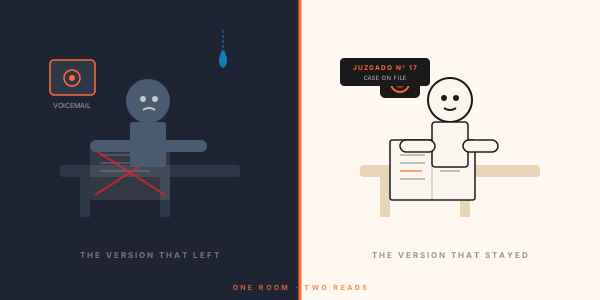
IN-KluSo illustration 2 — split room, two residents

The version that left

The apartment was fine. It was always fine, until it wasn't. The first leak she could explain. The second one, she reported. The third time the ceiling came apart she called the management company and got a voicemail, then an email, then a form. The form asked her to describe the damage. She described it. Three weeks later, nothing.

She had a job. She had a deposit saved. She took the fund's offer — "generous economic agreement," they called it — and signed. The building was exhausting her. She wanted to stop being exhausted. She was current on rent the whole time. That part still bothers her.

The version that stayed

He's been in the building for twenty-eight years. His lease is month-to-month now, which technically means nothing, which technically means everything. He documents. He photographs. He attends the Sindicato meetings. He knows the names of the lawyers and the names of the executives and the case number at Juzgado nº 17.

He is not a hero. He will tell you this directly. He is a person who decided that leaving on their terms was worse than staying on his. The distinction matters to him. He's not sure it matters to the fund.

The gap between those two versions isn't courage. It's not even resources. It's what each person decided the cost of staying was worth — and neither answer was wrong. What changed is that for the first time, a Spanish court agreed to examine whether the options were real choices or a managed funnel. That's a different question than who stayed and who left. It's a question about whether the condition itself was manufactured. The hearing is on March 3.
Thrust Where Capital Is Pointed

The 2,831-Building Ordinance Is a Capital Policy, Not a Housing One

Madrid's governing party opened a conversion pathway for 17% of the historic center's residential stock. That's not a housing decision. That's a capital allocation signal.

IN-KluSo illustration 3 — capital flow diagram

The Ayuntamiento de Madrid's 2024–2025 housing ordinance created a legal pathway for up to 2,831 buildings in the historic centro to reclassify from residential to tourist use. The ordinance was enacted by a PP-governed city hall. In the same period, the city saw the first criminal prosecution of a real estate investment fund for housing harassment.

These two things are not in contradiction. They are in sequence.

The ordinance accelerates the financial logic that makes the harassment business model attractive. The criminal prosecution is the first mechanism testing that logic from the other end. The question for purpose-driven capital — funds that claim to back housing, community, and place — is which side of this dynamic they're on, and whether they've looked.

In November 2025, a Catalan tenant union blocked a multimillion-euro property sale and secured 1,700 formerly private apartments for permanent public protection. Madrid tenant organizers are citing this as a reference point. The Casa 47 proposal — a new state housing company — was submitted to the Ministry of Housing by the same tenant networks the week before the Tribulete executives testified. These are structural responses, not campaigns. The capital landscape is shifting.

/ FRICTION — What Purpose-Driven Capital Won't Say in the Room

Impact investment talks about housing as infrastructure. What it doesn't say: most impact housing funds are underwriting yield, not continuity. The distinction matters when the building next door is being emptied through construction noise and the fund's LP deck describes the same corridor as "high-potential residential transition."

Writers: Juan Echeverri & Camilo Osorio

Axis Who Owns the Infrastructure

La Canica Was a Social Bank. Now It's Four Tourist Apartments.

In Lavapiés, a community space that operated as an informal credit union, gathering room, and cultural anchor for over a decade was evicted in June 2024. What replaced it was faster and cleaner.

La Canica wasn't licensed. It operated in the gap between what the city formally permitted and what the neighborhood actually needed: a place where people could store small amounts of mutual credit, organize events, meet without buying something, and maintain the social infrastructure of a barrio that had been losing it incrementally for years.

In June 2024, it was evicted. The space converted to four tourist apartments.

The people who organized La Canica didn't disappear. They moved — into the Sindicato, into the legal strategy, into the documentation infrastructure that is now producing evidence at Juzgado nº 17. The creative and social organizing capacity that ran an informal community bank is now running a criminal case support network.

This is what happens to cultural infrastructure when its physical home is removed: it doesn't dissolve, it migrates. And it tends to migrate toward harder structures. The question for cultural collectives is not whether they can survive displacement. It's whether they can anticipate the cost before the eviction notice arrives — and build the documentation, legal partnership, and redundancy before they need it.

/ FRICTION — What the Cultural Sector Won't Say About Resilience

Cultural collectives talk about resilience. What they don't say: most collectives operate without formal legal structure because formalization costs money they don't have. When the eviction comes, the informality that made them accessible is the same thing that makes them legally invisible. Resilience starts earlier than the crisis.

Writers: Juan Echeverri & Camilo Osorio

Flow How It Moves

The #NosQuedamos Map Is Crossing Barrio Lines

The organizing strategy from Lavapiés is now documented in Malasaña. That's not a neighborhood story anymore.

IN-KluSo illustration 4 — movement map crossing barrio lines

The #NosQuedamos strategy — documented, deliberate, legally coordinated — was born in Lavapiés. It is now active in at least five locations: Tribulete (Lavapiés), San Ildefonso, General Lacy, Mesón de Paredes, and Valverde 42 (Malasaña).

Malasaña is not Lavapiés. It was absorbed into the tourism and creative-class economy a decade before Lavapiés started facing the same pressures. The fact that it now has an organized resistance bloc using the same framework signals something about the strategy's replicability — and about how far the business model has traveled.

This is not a unified movement with central leadership. It is a distributed network operating the same playbook from different buildings. The playbook is: stay, document, litigate, hold. The distribution is what makes it durable. There is no single node to remove.

On February 18, 2026, residents of more than thirty blocks across Madrid delivered letters to the Ministry of Housing demanding Casa 47 acquire more than 15,000 apartments. In November 2025, the Catalan equivalent secured 1,700 apartments. Madrid organizers are citing Barcelona explicitly. The strategy is traveling between cities, not just neighborhoods.

/ FRICTION — What Community Building Platforms Won't Say About Scale

Community building platforms talk about scale. What they don't say: the most durable community infrastructure in Spain right now is being built by tenant unions operating without apps, without venture backing, and without growth metrics. The signal isn't that technology doesn't help. It's that the communities building real structural power are the ones that don't need it to start.

Writers: Juan Echeverri & Camilo Osorio

Ground Territory

The Corridor That's Being Contested

Lavapiés and Embajadores are not gentrifying. They're being converted. The distinction matters for how you read what's happening — and where it goes next.

IN-KluSo illustration 5 — balcony scene with crowd below

Gentrification is a market process: rising rents, shifting demographics, cultural replacement through economic pressure. Conversion is a policy-enabled process: regulatory reclassification, asset repositioning, and the deliberate removal of residential use from buildings through legal mechanisms that the market alone wouldn't produce.

Madrid's 2024–2025 ordinance is a conversion instrument. The 2,831 buildings it unlocks for tourist use are concentrated in the historic centre: Lavapiés, Embajadores, Malasaña, Chueca. These corridors are not simply becoming expensive. They are being reclassified.

The Tribulete 7 case is one data point in this pattern. La Canica's eviction is another. The #NosQuedamos buildings represent a third: the map of organized resistance is also a map of contested corridors. These are not isolated incidents — they cluster. And they cluster in the same zones targeted by the conversion ordinance.

For anyone thinking about territory in Madrid: the legal landscape shifted in December 2025 when a judge admitted the first criminal case against a fund for housing harassment. The ordinance and the case are running simultaneously. Neither has concluded. Both are reshaping the risk calculus for buildings in these corridors, on opposite ends.

/ FRICTION — What Real Estate Market Analysis Won't Name

Real estate market analysis in Madrid describes these corridors as "transitioning." What it doesn't say: the transition is not organic. It is enabled by a specific ordinance enacted by a specific governing party. The structural context isn't background — it's the product. Market analysis that doesn't name the policy instrument isn't analysis. It's decoration.

Writers: Juan Echeverri & Camilo Osorio

Synthesis The Frame

One Legal Threshold Changes Everything Downstream

"A verdict isn't required for a shift to happen. The threshold was admissibility."

The Tribulete case hasn't concluded. No one has been convicted. The fund hasn't been ordered to pay or to stop. Everything is still in instruction phase.

And yet: a judge reviewed the evidence and decided there was enough to proceed. That decision — admissibility, not verdict — is the structural event. It means that the next fund operating a similar model in a similar building in a similar corridor now faces a different calculation. Not just ethical. Financial. Legal exposure has a cost. The cost is now quantifiable. That's new.

The system didn't change because of activism. It changed because tenants with thirty-year leases documented harassment precisely enough, for long enough, through enough channels, that a judge agreed it was worth examining. The organizing was the prerequisite. The documentation was the mechanism. The court was the venue. These are three different things that had to work in sequence.

This is what structural change looks like before it's called structural change: one threshold crossed, the downstream implications not yet fully priced.

Watchlist What to Track

5 Signals to Watch — Madrid 2026

What to monitor. One signal per domain.

Legal

Tribulete 7 verdict or dismissal — If the instruction phase results in charges going to trial, it establishes formal precedent in Spanish criminal law. If dismissed, the civil pathway remains the only route. Track: LegalToday, El Salto Diario housing desk.

Thrust

#NosQuedamos building count — Currently documented in at least five locations. If this number rises, the model is replicating. If it plateaus, the Tribulete outcome matters more. Track: Sindicato de Inquilinas public communications.

Policy

Casa 47 formation and acquisition scope — The proposed national housing company is a policy variable. Whether it advances or stalls in Madrid's contested corridors is a direct institutional response indicator. Track: Ministerio de Vivienda announcements.

Ground

Tourist apartment conversion applications under the 2,831-building ordinance — If applications rise in Lavapiés/Embajadores after Tribulete draws legal scrutiny, the ordinance is operating faster than the legal challenge. Track: Ayuntamiento de Madrid urban planning.

Flow

Similar criminal complaints in Barcelona or Valencia — El Salto Diario notes these pressure tactics are "increasingly common in all cities." If querejas modeled on Tribulete 7 appear in other Spanish jurisdictions in 2026, the legal strategy has traveled. Track: Sindicat de Llogateres (Catalunya).

Crumbs IN-KluSo Data Signals Division

CRUMBS // Madrid Edition

Raw intelligence layer. Max 18 words per crumb. What the numbers and fragments say before the narrative catches up.

Territory

2,831 buildings in Madrid's historic centre cleared for residential-to-tourist reclassification under 2024 ordinance.

Ayuntamiento de Madrid · 2024–2025 ordinance
Legal

First criminal case for housing harassment against a real estate investment fund admitted to Spanish courts: December 2025.

LegalToday · Juzgado de Instrucción nº 17
Capital

Elix Rental Housing II ownership traces to AltamarCAM Partners. AltamarCAM: one of Spain's larger private equity groups.

Corporate registry · El Salto Diario
Organizing

#NosQuedamos documented active in 5 Madrid locations across 3 barrios. Strategy crossing neighborhood lines.

Sindicato de Inquilinas e Inquilinos de Madrid
Culture

La Canica evicted June 2024. Replaced by four tourist apartments. Organizers migrated to legal strategy infrastructure.

Lavapiés · Cadena SER Radio Madrid
Signal — Radar Only

Biznaga played from the Tribulete balconies during the December 2024 funeral march. The set came from inside. The building still had people in it. That detail is the whole story.

Tribulete 7 · December 2024
Policy

Casa 47 — proposed national housing company — requested to acquire 15,000+ Madrid apartments by tenant coalition. February 18, 2026.

Ministerio de Vivienda · Madrid tenant networks
Elsewhere

Catalan tenant union blocked multimillion-euro sale, secured 1,700 apartments for permanent public protection. November 2025. Madrid organizers citing this explicitly.

Sindicat de Llogateres · Catalunya
← Back to Magazine · Research Tools