February 19, 2026 · Year Umbrella: Economies with Purpose

IN-KluSo

"Ideas Worth Existing"

Year Umbrella: Economies with Purpose

← Back to Archive
IN-KluSo illustration 0
Core The Editorial

Not Every Idea Deserves to Exist. Yours Might.

The validation culture didn't fail because people test too little. It failed because they test the wrong things — and celebrate the results either way.

IN-KluSo illustration 1

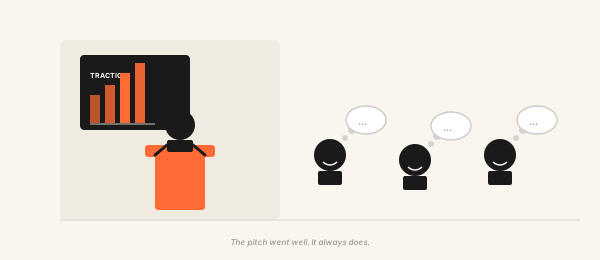
The pitch went well. It always does. There's a particular kind of founder who can make almost any idea sound inevitable — TAM, ICP, PMF, the right pauses in the right places. The deck is beautiful. The waitlist has 400 names. The problem, if you ask hard questions, is that 380 of those names are people who were too kind to say no.

This is the texture of idea failure in 2026: it doesn't look like failure. It looks like early traction.

The failure rate for new ventures has always been high. That's not the signal. The signal is this: the type of failure has changed. A decade ago, most ideas failed because the market wasn't there. Today, they fail because the architecture was wrong from day one — the operating model was designed around a fundraising cycle instead of a customer one, the governance was improvised and never formalized, the community was assembled instead of found. The market was there. The structure wasn't built to reach it.

This is a structural problem wearing a market problem's clothes.

What separates an idea that deserves to exist from one that merely sounds like it should:

Not the concept. Not even the founding team. It's the architecture underneath — the operating logic that remains when the founding energy runs out, when two team members leave in the same month, when the grant application is rejected, when the algorithm stops rewarding what you built.

An idea that deserves to exist has a structure that can survive its own success and its founders' absence. That's a higher bar than most validation frameworks ask for. It's also the only bar that matters.

This edition is built around that gap — and what it looks like when you close it deliberately.

The four structural questions this issue answers:

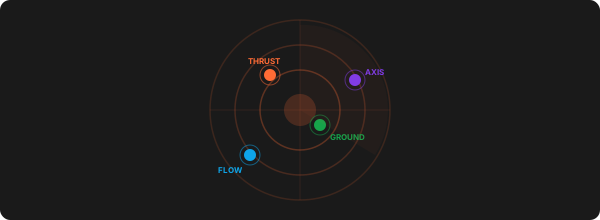
→ Can your model sustain itself without a third party deciding it should exist? (THRUST)
→ Can your project outlast the specific people who started it? (AXIS)
→ Can you find your audience without gaming a platform that will change its rules anyway? (FLOW)
→ Are you treating physical space as a capital decision or a comfort decision? (GROUND)

These are not philosophical questions. They're diagnostic ones. The answers tell you whether you have an idea or a model — and whether you're building something or performing the appearance of building.

The question was never whether the idea was interesting. Interesting is easy. The question is whether it's real — and whether you're willing to find out before you ask anyone else to believe in it.
/ FRICTION — What the Innovation Ecosystem Won't Admit

The startup ecosystem is not designed to help ideas survive. It's designed to generate deal flow.

Accelerators need applications to select from. Pitch competitions need participants to fill brackets. Startup weekends need attendees to justify the venue. Innovation hubs need resident companies to justify the building. Each of these institutions benefits from a high volume of active founders — not from a high percentage of successful outcomes. The incentives are not aligned.

This means the infrastructure that surrounds early-stage ideas is optimized for the activity of innovation, not its results. The accelerator gets its equity whether or not the company survives. The pitch competition produces a winner regardless of whether that winner was ready to be one. The mentor's reputation survives the company's failure without a scratch.

What nobody in this ecosystem says plainly: the current architecture of innovation support actively subsidizes the continuation of bad ideas. Not through malice. Through incentive structures that reward engagement, not outcomes.

The founder who enters an accelerator with a structurally broken model leaves with better pitch skills, a 6% dilution, and the same broken model — now six months older, and slightly more confident in its wrongness. The honest version of support would include someone who tells you to stop. The ecosystem is not built to produce that person.

We built a system that works as long as nobody measures what happens after the cohort ends. The honest accounting of any accelerator program would track not what percentage of companies raised a next round, but what percentage were operationally sound 18 months after graduation. That number is available. It is not in the marketing deck.

Writers: Juan Echeverri & Camilo Osorio

Downtown Encounter

One Room, Two Reads

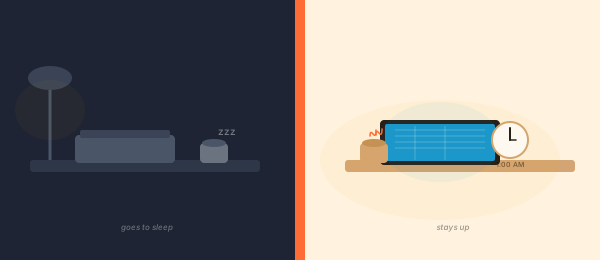
Same person. Same Tuesday night. Two ways of being in it.

IN-KluSo illustration 2

The version that goes to sleep

The spreadsheet is closed. The idea is good — she knows it's good — but good ideas don't pay February. She's run the numbers four times. The market exists. The timing is real. What isn't real yet is the first customer, the first dollar, the first signal that someone outside her apartment agrees with her.

She saves the file. Opens something else. The idea can wait until tomorrow.

The version that stays up

It's 1 a.m. and she's still in it. Not obsessing — building. The spreadsheet is open because she's solving something, and solving feels different than worrying. The market exists. She's not inventing demand, she's locating it. That's half the work, maybe more.

Apparently "just go find your first customer" is a complete business strategy now. She knows. She's doing it. It's just that nobody tells you finding them feels like sending letters to an address you're not sure exists.

The gap between those two versions isn't confidence. It's not even clarity. It's permission — the structural belief that what you're building has the right to take up space before it's proven. Most validation frameworks skip this part. They tell you to test assumptions, not to examine whether you've allowed yourself to be wrong in public. The idea doesn't need more research. It needs an owner who's decided to find out.
Four Lens

Four Lens Breakdown

One signal. Four domains. What each section is really saying this edition.

/ Thrust

Early-stage funders in LATAM revised their intake criteria in Q4 2025 to require operational narratives alongside pitch decks — the structural clarity mandate has entered the process, not just the conversation. A model designed around a fundraising cycle rather than a customer one is now a disqualifier before the first meeting. Run the Structural Validation Grid before your next funder conversation and note which questions you cannot answer with specifics — that's the gap the capital market has already located.

/ Axis

Cultural accelerators across Spain, Colombia, and Argentina have formalized an intake category for "functional concept, broken governance" — the sector has named the problem it spent a decade aestheticizing. Creative projects that outlasted their founding moments didn't do so through alignment; they did so through documents, and the distinction is no longer theoretical. If your project's continuity depends on three specific people staying aligned, you don't have infrastructure yet.

/ Flow

Platform data confirms that community-origin projects retain audiences at 40–60% higher rates than content-origin projects at the six-month mark — the algorithm follows the community, it does not build one. A posting schedule produces metrics; a named tension produces people who came looking — and only one of those survives a platform shift or a change in what the recommendation engine decides to reward.

/ Ground

In markets like NWA and Boise, listings with dedicated workspace language command a 4–7% price premium and spend 18% fewer days on market — the capital market has already priced what most buyers are still treating as a secondary amenity. The household that eliminates a coworking lease and works from home full-time has made a capital allocation decision; the only variable is whether they made it consciously or by default.

Thrust Purpose-Driven Capital

The 30-Day Validation That Actually Works

Most founders test demand. The ones who survive test structure — and they're not the same test.

IN-KluSo illustration 3

Upstream Signal: Across LATAM and US-based Latino founder ecosystems, early-stage funders — particularly impact-aligned angels and community-backed vehicles — are declining deals not for lack of demand evidence, but for lack of operational clarity. The pitch is strong. The model is missing. This is new.

Three impact-focused early-stage funds in Colombia and Mexico revised their intake criteria in Q4 2025 to require an operational narrative alongside a pitch deck — explicitly asking: "How does this pay for itself when the grant runs out?" This question didn't used to be in the intake form.

LAVCA failure data shows that ventures dissolving in months 12–24 share one consistent pattern: the revenue model was designed around a fundraising cycle, not a customer one. The model worked fine — until the fund didn't renew.

Three Questions Structural Validation Actually Answers

1. Can this model sustain itself without a third party deciding it should exist?

Remove the grant. Remove the early angel. Remove the accelerator stipend. Remove the founder's sweat equity being counted as free labor. What remains? If the answer is "not much," the idea hasn't been validated. It's been subsidized. Subsidies are not structure. They're a clock.

2. Who loses something specific if this stops?

Not "who would be interested" — who would be harmed by its absence. This is the difference between a nice-to-have and a structural need. The honest version: would anyone notice in 90 days? In 6 months? If the answer is "they'd find a workaround," you're building a convenience. If the answer is "they'd have a real operational problem," you're building infrastructure.

3. What is the unit of value, and can it be priced honestly?

This is where creative and purpose-driven ventures break. Pricing feels like a values compromise. It isn't. It's a diagnostic. If you cannot price what you produce — if every pricing conversation gets deferred because it "doesn't feel right yet" — you haven't finished designing the model. You've designed the mission. Those are different things, and confusing them is the most expensive mistake in the impact economy.

Case — Before the Seed

A Medellín-based collective building financial literacy tools for informal economy workers spent their first 3 months on discovery calls and waitlist building. Traction looked good. A local fund asked them to complete a structural validation exercise before moving forward.

What they discovered: their pricing assumption required a $12/month subscription from a user base earning $400/month. The model wasn't wrong — but it couldn't survive contact with reality as designed.

They rebuilt the pricing architecture around employer partnerships — businesses with informal workforces who had compliance incentives to offer financial education. They launched 8 months later with 3 paid B2B contracts, $0 in grants, before they raised a single peso of external capital. The demand was always there. The model is what changed.

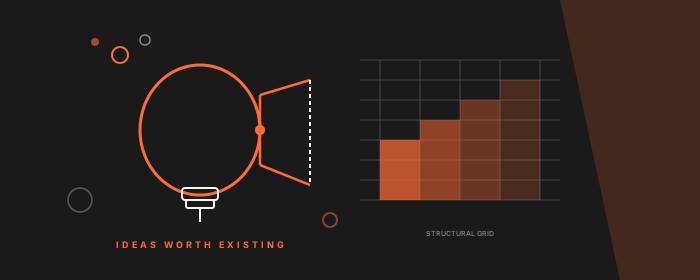
The Structural Validation Grid

Question Honest Answer What it reveals
Who pays, and why specifically now?Revenue architecture
What breaks when volume doubles?Operational ceiling
What does year 2 look like without new funding?Sustainability logic
Who is measurably worse off if you stop?Structural need
Can you price the unit of value?Model completeness

Demand tells you people are interested. Structure tells you whether there's something worth building for them.

/ FRICTION — What Impact Investors Won't Say in the Room

Most impact investment is not about impact. It is about the story of impact — and those are structurally different things.

A fund with LP commitments from institutional endowments and family offices needs a narrative. "Portfolio companies generating measurable social return in underserved communities" is a narrative. It performs in fundraising decks. It satisfies ESG reporting requirements. What it doesn't require is that the impact be real.

The metrics used to evaluate impact are almost entirely determined by what's legible to the investor, not what matters to the community. Legible metrics travel. Actual community outcomes are messy, slow, and hard to attribute cleanly to any single intervention. The system selects for the measurable, not the meaningful.

Founders who survive this landscape understand what it actually is: a narrative market dressed as a capital market. You build for the community first. Then you learn to translate — not the other way around. The founders who learned the translation first are building for the investor's marketing needs. Most of them know it. None of them will say it.

Writers: Juan Echeverri & Camilo Osorio

Axis Exponential Creativity

The Concept That Became a Project, Then Stopped

Most creative projects don't die from lack of creativity. They die from a conversation no one had in the first eighteen months.

IN-KluSo illustration 4

Trust and shared vision are not governance. This needs to be said plainly because it contradicts something deeply embedded in creative culture: the idea that formalizing a project betrays its spirit. That writing things down introduces a corporate logic that doesn't belong in community spaces. That if you trust your collaborators, you don't need documents.

This belief is understandable. It is also how most creative projects end.

There is a specific moment in the life of a creative project that no one warns you about. It arrives somewhere between month 6 and month 18. The concept has been proven. A community is forming around it. External interest is arriving — a residency offer, a collaboration, a small grant application. And then the founding team realizes: we don't actually know how we make decisions. We don't know who owns the intellectual property. We don't know what happens if one of us leaves.

This isn't a failure of trust. It's a failure of infrastructure. Alignment is not durable. It doesn't survive major decisions, external pressure, or the entirely normal human experience of people changing their minds about what they want.

If your creative project depends on the continued alignment of three specific people, is it a project — or is it a relationship with a logo?

The Three Documents Every Creative Project Needs Before Year 2

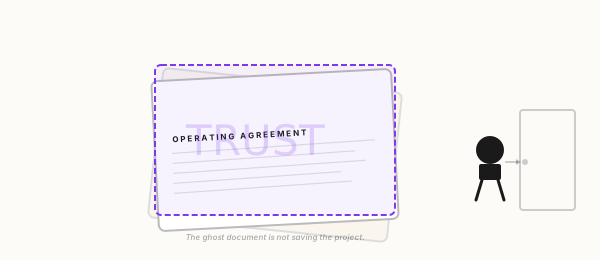
1. The Operating Agreement
One page. Covers: how decisions get made (consensus, veto, majority — pick one and write it down), what happens when decisions can't be made, who holds accountability for what function, and how the founding team changes if it needs to. The most important question in this document is the one nobody wants to answer: what is the process for a founding member to exit? Skipping this question doesn't prevent the exit. It just makes it catastrophic when it happens.

2. The IP Clarity Map
Who owns the work the project produces? Who owns the name, the brand, the methodology? If a founding member leaves, what do they take with them — and what stays? Creative projects avoid this conversation because it feels mercenary. It isn't. It's respect for what you've built together.

3. The Continuity Protocol
One question, honestly answered: what is this project without its founders? If the answer is "nothing," it's not a project yet — it's a platform for specific people. A project with a continuity protocol is designed to outlast them.

Case — The Bogotá Dissolution

A visual arts collective in Bogotá, operating since 2021, built something genuinely original: a hybrid program of exhibitions, international residencies, and a youth workshop series that had real community impact and serious institutional attention. By late 2024, two of the four founding members had decided to pursue other paths. The split was amicable. The conversation was respectful.

The project did not survive it. There was no operating agreement. There was no IP clarity. There was no continuity protocol. The brand dissolved in four months. The community the project had built — real, active, invested — dispersed across individual social accounts with no center of gravity.

The concept was strong. The architecture wasn't there to carry it. The concept gets you started. The structure is what lets it outlast you.

/ FRICTION — What the Creative Sector Won't Say About Who's Doing the Work

Most cultural collectives have one person who actually runs them. It's usually the person with the least public profile. Often the one who didn't need external validation to stay committed. Almost always the one whose departure ended the project — and whose contribution, retrospectively, nobody knew how to credit because it was never formalized.

The creative sector has a structural problem with invisible labor that it addresses almost entirely through aesthetics. Collective credits. Flat hierarchies on the website. "We" language in every statement. The appearance of distributed contribution obscures a reality that anyone inside these organizations already knows: one person is holding the operational reality together, and they are not being compensated for it.

The governance conversation — the operating agreement, the IP map, the exit clause — is not primarily a legal question. It's an ethics question. The person doing the invisible work deserves to have it named, priced, and protected. Organizations that refuse to name it are not practicing flat hierarchy. They're practicing plausible deniability about their own labor structure.

When that person leaves, the project doesn't "evolve." It ends. And the field calls it a creative transition.

Writers: Juan Echeverri & Camilo Osorio

Flow The Immersive Power

You Don't Build an Audience from Scratch. You Find One Already Forming.

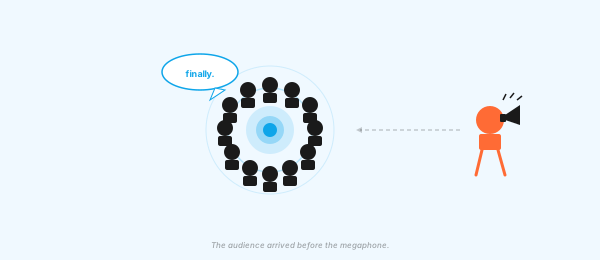
"Build an audience" is the wrong instruction. The signal-literate move in 2026 is community detection — finding where attention is already organizing and arriving before the algorithm decides to notice.

IN-KluSo illustration 5

"Build an audience from scratch" contains a hidden assumption: that the audience doesn't exist yet, and your job is to create it. This is wrong in a way that matters operationally.

Every community forms around something: a shared frustration, a shared aspiration, a shared identity that doesn't have a name yet. The tension exists before the content does. The question isn't "how do I attract followers?" It's "what tension already exists in this space, and who is already carrying it without anywhere to put it?"

Content-first: Define what you want to say → Find channels to say it → Optimize for algorithmic reach → Hope the right people find you.

Community-detection: Map who is already clustering around a tension you understand → Name that tension in public, precisely, before anyone else has → Build the infrastructure for that cluster → Become the meeting point.

The first approach is faster to feel like it's working. A content calendar produces output. Output produces metrics. Metrics produce the sensation of progress. The problem is that most of what it produces is passive followers who will forget about you the next time the platform decides to show them something else.

The second approach is slower to feel like it's working. It produces, at first, a smaller number — but a different kind of number. People who found themselves in what you wrote and came looking for more.

Is your content strategy designed to attract people, or to give a specific group of people something they were already looking for?

Community Detection Framework

Step 1: Map the tension landscape (2 weeks, zero publishing)
Before posting anything, only consume. What conversations keep restarting without resolution? What topics generate comments longer than the original post? Where do you see people saying "finally someone said this" — and what did that person say? The tension landscape is already there. You're reading it, not inventing it.

Step 2: Name the tension — not the solution
One piece of content. Not an answer — a precise articulation of what the community is already feeling but hasn't said yet. The goal is recognition. You'll know it worked when strangers tag other strangers in the comments.

Step 3: Build the container before the content calendar
What is the ongoing infrastructure for this conversation? A newsletter with a specific editorial position. A community channel with a stated focus. A recurring live format around a recurring tension. Build the structure before you optimize the output — because a community with no home disperses.

Case — The Financial Analyst Who Didn't Try to Grow

An independent financial education voice in Medellín wrote one LinkedIn essay in October 2024. The essay named one specific tension: the way traditional financial advice in Colombia assumes a savings capacity that most urban professionals simply don't have. No savings tips. No five-step framework. Just a precise naming of a thing that everyone in her network had felt and nobody had said plainly.

40,000 impressions. 600 saves. 90 direct messages from strangers in the first 72 hours. She launched a Substack the following week. 1,200 subscribers in 45 days. Not one post about "how to grow your newsletter."

She didn't build an audience. She found one that was already there, already carrying the tension, already waiting for someone to name it accurately enough that they felt seen.

/ FRICTION — What Community Platforms Won't Tell You About Your Metrics

Engagement metrics are not community metrics. The platforms — Discord, Substack, Circle, Geneva — report what they can measure, which is activity: messages sent, posts opened, members added, retention week-over-week. These numbers feel like evidence of community health. They aren't.

A community is healthy when members hold each other accountable, challenge each other's thinking, and remain invested even when the content isn't good. Activity metrics measure presence. They don't measure investment.

The platform companies will not say this because their pricing is based on member counts, not member quality. The community manager who builds a 5,000-person channel of passive followers gets the same enterprise tier as the one who builds 400 people who genuinely rely on each other — but the second community is worth more by every meaningful measure.

The harder truth: real community has friction in it. Disagreement. Accountability. Shared stakes that create discomfort. Most community builders deliberately sand down the friction because it's uncomfortable to manage — and in doing so, they sand down exactly what makes it real. Real community health is not measurable at scale. That's not a limitation of current tools. That's a feature of what community actually is.

Writers: Juan Echeverri & Camilo Osorio

Ground Smart Spaces

The Office You Build at Home Is the First Real Estate Decision You'll Make

The home workspace is not a lifestyle upgrade. It's a capital allocation decision — and most people are making it without knowing they're making it at all.

IN-KluSo illustration 6

The home office in 2026 is not a room with a desk. For a specific and growing class of worker in markets like Northwest Arkansas, the home workspace is a tax-deductible business asset, a productivity infrastructure that directly affects income capacity, a resale value driver in markets with high concentrations of remote workers, and a negotiating position in employment conversations.

NAR data (Q4 2025) shows that in markets with high concentrations of remote and hybrid workers, listings with "dedicated office" or "workspace" language are spending 18% fewer days on market than comparable listings — and commanding a 4–7% price premium. The market has priced the workspace. The buyers haven't.

Northwest Arkansas is one of the most unusual remote-work markets in the country, and it's underanalyzed as such. The Walmart and supplier ecosystem generates a concentration of hybrid workers — corporate employees in-office 2–3 days/week — whose workspace requirements are specific and whose purchasing power is real. These are dual-income professionals with explicit business productivity needs who are choosing between a Bentonville coworking membership and a purpose-built room in their own home.

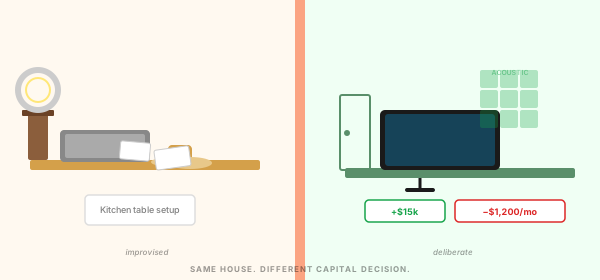
If your home workspace directly affects your earning capacity, why are you investing more in your kitchen than your office?

The Workspace Capital Audit

Factor Questions to Answer What it reveals
Dedicated workspaceDoes the space have genuine separation — a door, acoustic integrity, professional-grade light?Whether productivity hours are recoverable
Tax positionAre you self-employed or 1099? Is this space documentable as primary business use?Whether the IRS is subsidizing the upgrade
Productivity costHow many hours per week are lost to an inadequate work environment? At your hourly rate, what does that cost?The real ROI calculation
Market signalIn your specific zip code, do workspace-designated listings command a premium?Whether your capital allocation has a real estate return
Monthly comparisonWhat does your current coworking situation cost? How does that compare to the mortgage delta for a property with dedicated workspace?The break-even on the capital decision

If a dedicated workspace adds $15,000 to a home's purchase price, and eliminates a $1,200/month coworking membership, the capital cost breaks even in 12–13 months — before accounting for tax advantages and resale position. This is not a lifestyle premium. It's a leverage decision.

The first piece of commercial real estate most people occupy is the room where they work. Most don't know they've moved in.

/ FRICTION — What Real Estate Content Won't Tell You About Who's Writing It

The real estate "market update" is a marketing document. This needs to be said plainly because the format — the charts, the median price trends, the absorption rate tables, the inventory analysis — has the appearance of neutral reporting. It is not neutral. It is produced by people who are compensated when transactions occur, not when they don't.

The broker who tells you the market is strong, inventory is low, and now is a good time to act has a structural incentive to deliver that message regardless of underlying conditions. This is not a criticism of individual agents — most of whom believe what they're saying — it's a description of the incentive architecture that determines what gets published and what gets withheld.

The analysis that would actually serve a buyer — "here are conditions under which you should wait," "here is how to model the downside scenario" — is almost never produced by industry content. It doesn't serve the transaction. So it doesn't get written.

Literacy in this market starts with knowing who produced the report and what they get paid when you act on it.

Writers: Juan Echeverri & Camilo Osorio

Systems Synthesis

What the Sections Prove Together

IN-KluSo illustration 7

"The gap between ideas that deserve to exist and ideas that merely sound like they should is not sectoral — it's architectural."

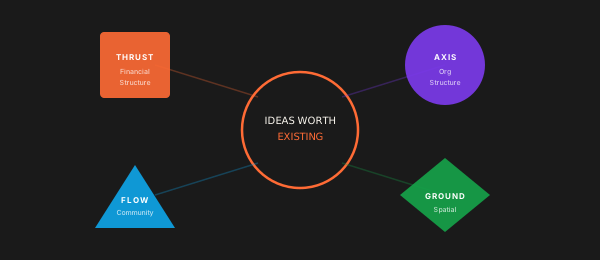
THRUST shows that financial sustainability is not a fundraising outcome — it's an operating logic that must be designed before the first external check arrives, because the fundraising cycle and the customer cycle are not the same clock. AXIS shows that organizational sustainability is not a trust outcome — it's a document that survives the exit of the person who trusted most, and the creative sector's resistance to writing that document is the single most consistent predictor of creative project failure in its second phase. FLOW shows that audience sustainability is not an algorithmic outcome — it's a structural relationship with a tension that preceded the content, and the projects that built their communities before their content calendars are the ones the algorithm now works for, not against. GROUND shows that spatial sustainability is not a lifestyle outcome — it's a capital decision made, consciously or not, the moment work moved home, and the households making it deliberately are already ahead of the market that hasn't caught up to their data.

Together, these four sections describe a single discipline: the practice of treating every dimension of a project — financial, organizational, communal, physical — as infrastructure that must be built with intention, before the founding energy that makes intention feel unnecessary runs out.

Watchlist

Next 30–60 Days

What to monitor. One signal per domain.

IN-KluSo illustration 8
Thrust

Watch whether LATAM-focused impact funds that revised their intake criteria in Q4 2025 begin publishing standardized operational assessment frameworks as public tools — if they do, structural validation is becoming a market standard, not a differentiator, and the founders who haven't built that vocabulary yet are now behind the intake process.

Axis

Watch whether any major cultural accelerator in the Ibero-American space announces a governance-specific programming track separate from its creative development curriculum — a structural signal that the "functional concept, broken governance" intake category has become large enough to constitute a distinct market, which means the window for addressing it before competitors do is shortening.

Flow

Watch LinkedIn's algorithm behavior through March 2026: if broadcast content continues to lose reach while collaborative posts, direct questions, and comment-heavy conversations continue to gain — the structural shift away from content-first distribution is confirmed as permanent rather than cyclical, and the playbook needs to change before the next editorial cycle.

Ground

Watch NWA transaction data for Q1 2026: if the 4–7% workspace premium holds or widens as the Walmart hybrid workforce fully normalizes home-office infrastructure spending, the window for workspace-aware buyers to acquire at pre-premium pricing is closing faster than the annual data cycle will capture — and the signal will be visible in days-on-market figures before it appears in price data.

Crumbs Data Signals Division

February 2026 — Signal Pack

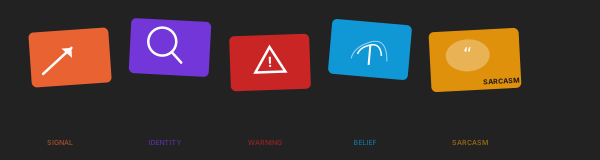
The raw intelligence layer. Max 18 words. No hype. Pull-quote ready.

IN-KluSo illustration 9
Identity

"We don't chase ideas. We audit them."

bio line, editorial header, IG caption
Identity

"IN-KluSo doesn't cover what's trending. It maps what's forming — before the trend has a name."

newsletter intro, about page, link-in-bio
Belief

"Before the pitch, there's the structure. One of those is optional."

THRUST promo, IG carousel opener
Belief

"A project that depends on three specific people staying aligned is not a project. It's a relationship."

AXIS pull quote, newsletter subhead, community post
Warning

"A waitlist is not validation. It's a room full of people too polite to say no."

THRUST promo, editorial aside, carousel slide
Warning

"Content-first community building is faster to feel like it's working. That's the problem."

FLOW promo, newsletter section break
Reframe

"The first piece of commercial real estate most people occupy is the room where they work."

GROUND promo, newsletter hook, IG caption
Reframe

"The audience isn't absent. It's waiting for someone to name what it already feels."

FLOW promo, community announcement, newsletter closer
Signal

"In NWA, listings with dedicated workspace language spend 18% fewer days on market. The data moved before the buyers did."

GROUND data promo, newsletter chart caption, LinkedIn post
Sarcasm

"The innovation ecosystem measures deal flow, cohort size, and demo day attendance. Outcomes are a future-state metric."

CORE/FRICTION promo, editorial aside, LinkedIn post
← Back to Magazine · Research Tools